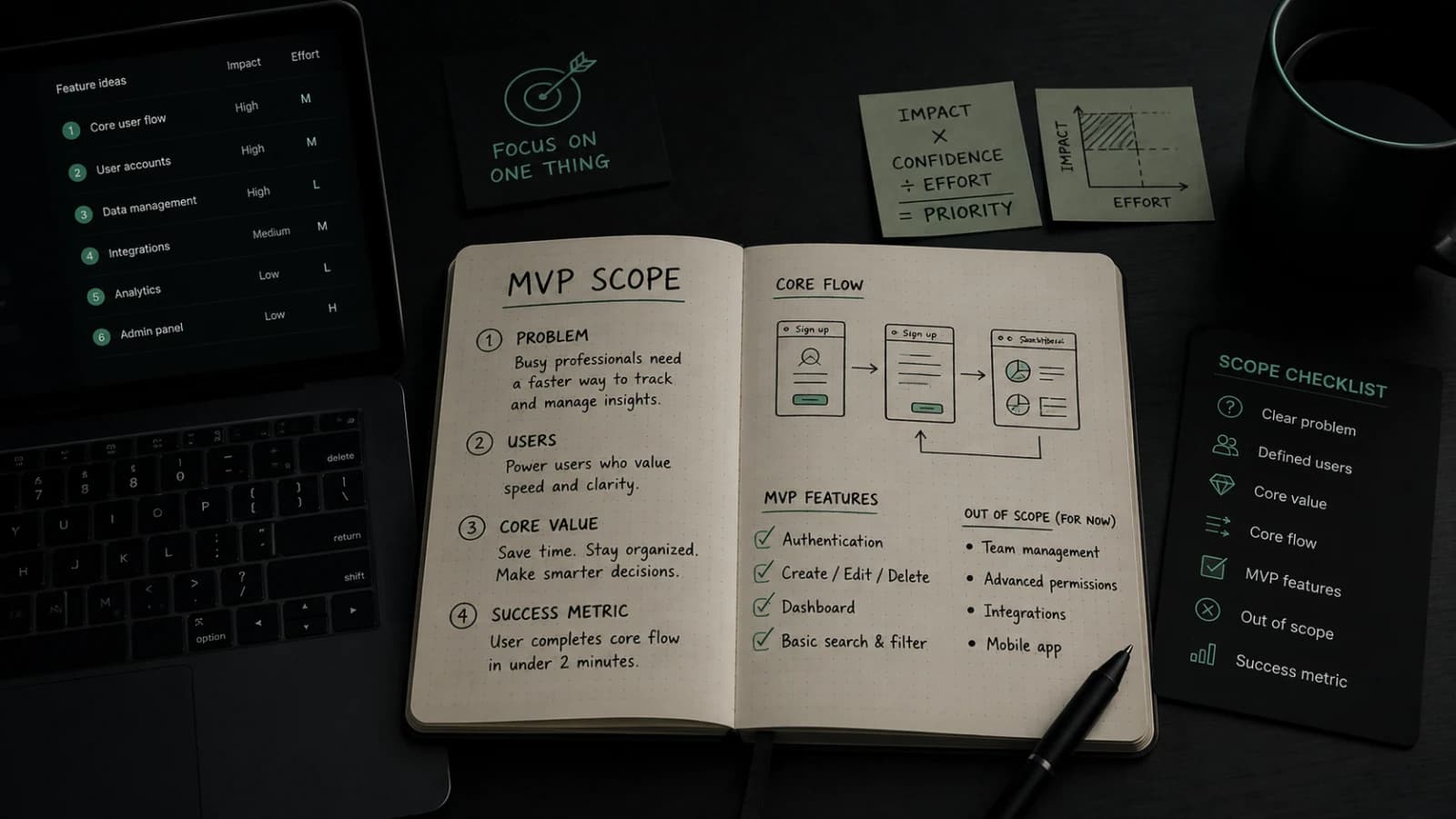
Most MVPs do not get into trouble because the first version is too small. They get into trouble because the first version is trying to be five products at once.
I have seen this pattern many times. A founder or a small team starts with a clear product idea, then the scope grows before anyone writes code. The first version needs authentication, a dashboard, payments, an admin panel, notifications, AI, analytics, roles, exports, onboarding, settings, and maybe a mobile app too.
None of those things are wrong by themselves. The problem is that they often show up before the team has answered the most important question:
What is the smallest useful workflow we need to prove?
That is what MVP scoping is really about. Not writing a perfect specification. Not removing every nice idea. Not making the product cheap for the sake of being cheap. A good MVP scope is a way to protect the first version from becoming too big, too vague, and too expensive before it has learned anything.
An MVP is not a smaller final product
A common mistake is to think of an MVP as the final product with fewer features. That sounds reasonable, but it usually leads to bad decisions.
If you start from the final product, everything feels important. The admin panel feels important. The billing system feels important. The analytics dashboard feels important. The perfect UI states feel important. The second user role feels important.
But an MVP should not start from the final product. It should start from the first product risk.
For example:
- Can users complete the core workflow?
- Does this solve a painful enough problem?
- Is the product shape right: web app, mobile app, browser extension, internal tool, API, or something else?
- Can the team operate the first version without building too much automation?
- Is there enough signal to justify the next version?
That changes the conversation. Instead of asking “what features should the product have?”, you start asking “what do we need to build to learn the next important thing?”
That is a much better question.
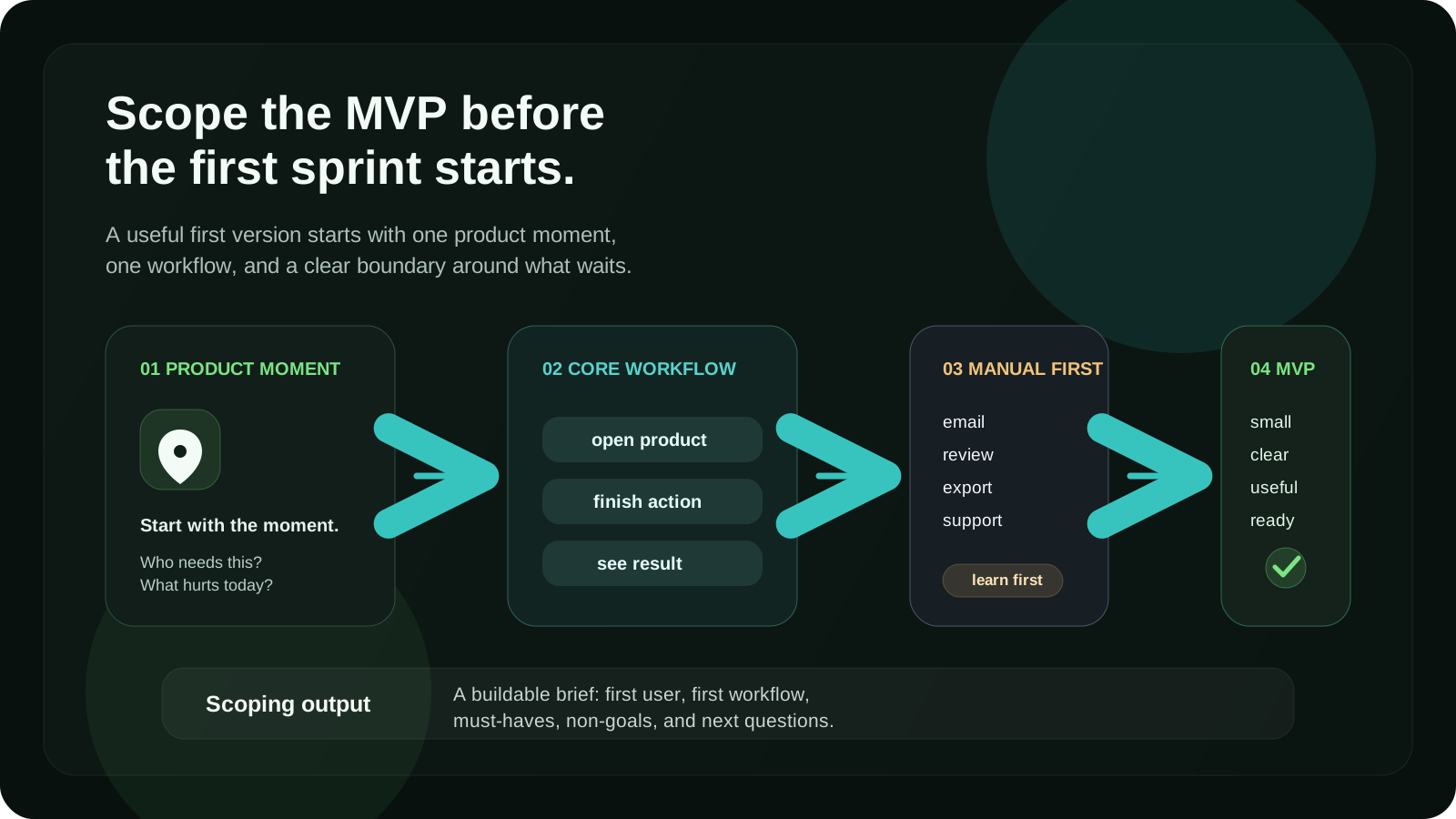
Start with the product moment
Before I think about tech, I like to understand the product moment.
A product moment is the situation where the user actually needs the product. It is not a feature list. It is not a database model. It is not a design system. It is the real-world moment where someone is trying to do something and the current way is annoying, slow, risky, manual, or unclear.
A few examples:
- A founder wants to review SEO and accessibility issues directly on a page without jumping between tools.
- A small team wants to replace a spreadsheet workflow with a simple internal dashboard.
- A coach wants to collect client progress from a mobile-first flow instead of sending forms manually.
- A marketplace operator wants sellers to create listings and buyers to contact them without building the whole marketplace platform yet.
When the product moment is clear, scope decisions become easier. If a feature does not support that moment, it is probably not part of the first version.
This is also where a developer should ask uncomfortable questions. Not to slow the project down, but to avoid building around an assumption that nobody has checked.
Questions like:
- Who is the first user?
- What are they doing today instead?
- What part of that workflow is painful?
- What does success look like after one session?
- What has to happen for the product to feel useful?
- What can still be manual in version one?
If these questions are hard to answer, that is not a problem. It just means the first step is not development yet. The first step is product clarification.
Define one core workflow
The fastest way to make an MVP scope practical is to write down one core workflow.
Not ten workflows. One.
For a SaaS product, it could be:
User connects data → reviews generated results → exports a reportFor a marketplace MVP:
Seller creates listing → buyer discovers listing → buyer contacts sellerFor a browser extension:
User opens a page → extension analyzes the page → user sees actionable issuesFor an internal tool:
Team member uploads data → manager reviews status → client receives summaryThis simple sequence is more useful than a long feature list because it shows how the product is supposed to behave. It also exposes what is missing.
If the workflow cannot be described in one or two lines, the product may still be too abstract. That does not mean it is a bad idea. It means it needs more shaping before a developer can estimate it properly.
A good MVP scope usually has one primary workflow and maybe one or two support flows. Authentication, settings, admin actions, and notifications can exist, but they should support the main workflow instead of becoming the product.
Separate must-have, later, and fake requirements
When a scope is unclear, every feature sounds like a must-have. I like to split requirements into three groups.
| Type | Meaning | Example |
|---|---|---|
| Must-have | The core workflow does not work without it | A user can create and submit the main form |
| Later | Useful, but not required to prove the first workflow | Advanced filters, saved views, team permissions |
| Fake requirement | Sounds professional, but does not reduce first-version risk | A complex admin panel before there are real users |
“Fake requirement” does not mean the idea is stupid. It means the timing is wrong.
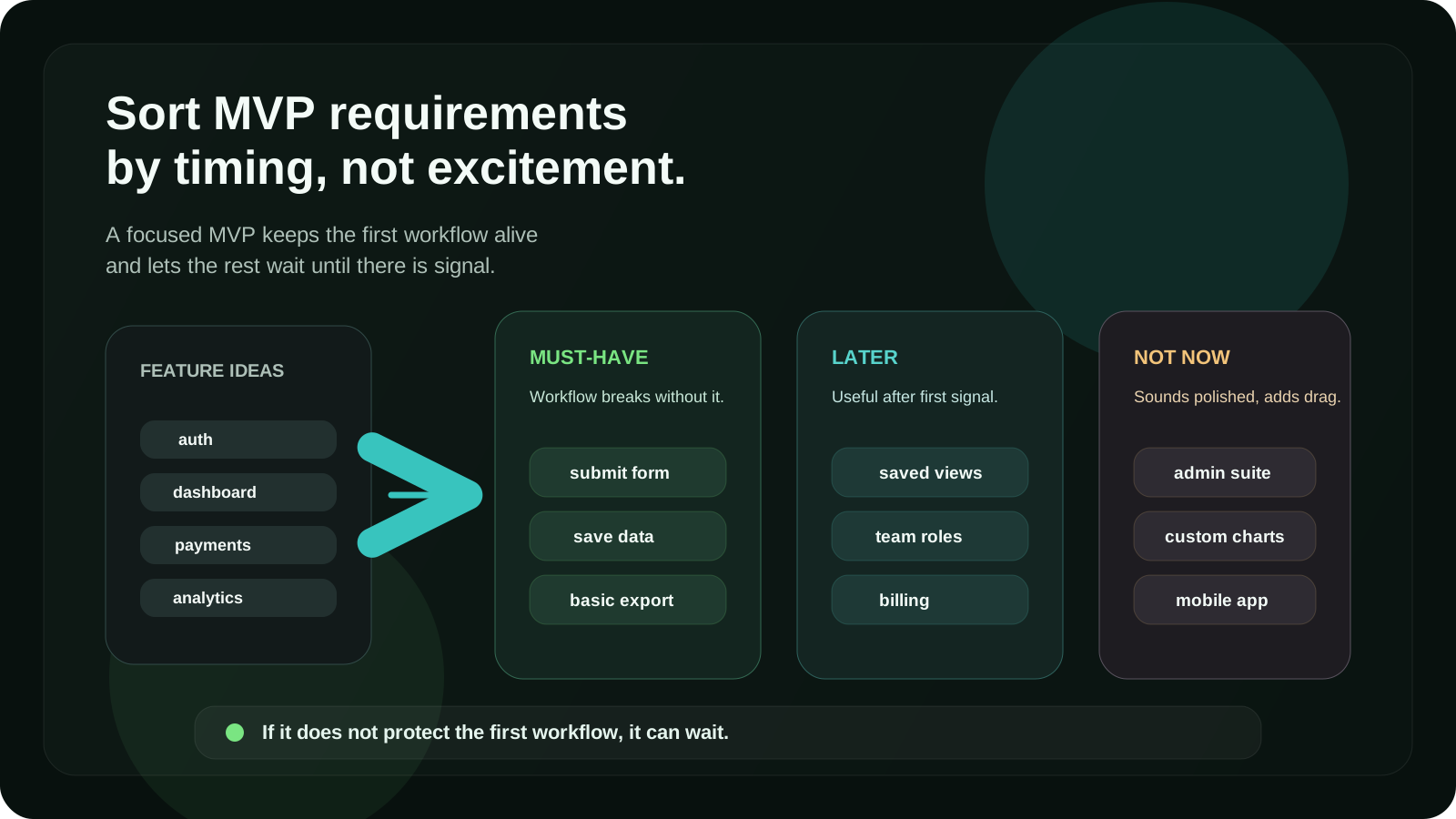
Some common fake requirements in early MVPs:
- advanced role management before there are different real user types
- custom analytics dashboards before there is meaningful usage
- full automation for operations that could be manual for the first customers
- mobile apps before the core workflow is validated on the web
- complex notification systems before the product has repeated usage
- a polished admin panel before the team knows what admins actually need
- a design system before the interface patterns have stabilized
The best MVPs are not the ones with the fewest features. They are the ones where every feature has a job.
Decide what can stay manual
This is one of the most important scoping decisions.
A lot of early products overbuild because they try to automate everything from day one. But not every operation needs custom software immediately.
In a first version, it is often fine if:
- onboarding happens manually
- some emails are sent by a person
- data is reviewed before being published
- reports are generated with a small internal step
- customer support handles edge cases directly
- payments are managed through an existing tool first
Manual does not mean low quality. Manual can be a deliberate product strategy. It lets you learn what the software should do before you hard-code the wrong process.
The question is not “can this be automated?” Almost everything can be automated. The better question is:
Does automating this now help us prove the product, or does it just make the
first version bigger?
If the answer is the second one, keep it manual for now.
Choose the technical shape after the workflow
A lot of teams start with technology too early.
They decide they need a mobile app, or a SaaS dashboard, or an AI product, or a browser extension before the workflow is clear. Sometimes that is right. Often it is just the most obvious shape, not the best one.
The technical shape should follow the product moment.
If the user needs to work inside a browser page, a browser extension might be a better first product than a dashboard.
If the user needs to capture something quickly during the day, a mobile-first flow might matter more than a complex web app.
If the product is mostly about managing internal operations, an internal tool might be the right MVP before a customer-facing platform.
If the main value is data processing, the backend and API design may be more important than the first UI.
If the idea is still being validated, a small web app may be enough before committing to native mobile development.
This is where product-minded engineering matters. The job is not just to pick a stack. The job is to pick the simplest technical shape that can prove the workflow without blocking the future.
Write the brief in plain language
Before hiring a developer, you do not need a huge technical specification. In many cases, a short plain-language brief is more useful.
A good MVP brief should answer these questions:
What are we building?
Who is the first user?
What problem are they trying to solve?
What is the core workflow?
What already exists today?
What should the first version definitely include?
What should it definitely not include yet?
What data does the product need to store?
Are there integrations?
Are there user roles?
Is design provided, or should the developer help shape the UX?
What is the expected timeline?
What would make the first version successful?
This does not have to be perfect. It just needs to be clear enough for a developer to understand the product direction and ask better questions.
The most useful part is often “what should it definitely not include yet?” That sentence prevents a lot of scope creep.
Do not estimate a vague product
A vague product can always be estimated, but the estimate will not mean much.
If someone asks for “a platform where users can manage projects, invite teams, track progress, get notifications, export reports, and use AI to improve their workflow”, the range could be enormous.
That could be a focused four-week prototype. It could also be a six-month product.
The difference is scope.
Before asking “how much will it cost?”, it is better to ask:
- What is the first workflow?
- What can be removed?
- What can be manual?
- What does the first user actually need?
- What does version one need to prove?
A good developer should not give you a confident fixed answer while the product is still blurry. They should help make the product less blurry first.
Example: scoping a browser extension MVP
Imagine the idea is a browser extension for reviewing websites.
The big version might include:
- page analysis
- SEO checks
- accessibility checks
- schema validation
- AI suggestions
- saved reports
- team workspaces
- history
- billing
- shareable links
- project dashboards
- integrations with other tools
That is too much for a first version.
A better MVP scope could be:
A user opens a webpage, runs an analysis from a side panel, sees a prioritized
list of issues, and exports a simple report.
Now the scope is easier to reason about.
Must-have:
- extension loads on the active page
- side panel UI
- core checks
- issue list with severity
- basic export
Later:
- team accounts
- saved history
- billing
- advanced report customization
- integrations
Manual or skipped:
- onboarding emails
- public dashboard
- complex account system
- organization management
This first version is much more buildable. It may still be useful. And it gives the team real feedback before investing in the bigger product.
Example: scoping a custom web app MVP
Now imagine a team wants to replace an internal spreadsheet with a custom web app.
The first instinct may be to build a full system:
- login
- dashboard
- CRUD for all entities
- roles and permissions
- audit logs
- notifications
- charts
- exports
- comments
- file uploads
- admin settings
Some of that may be needed. But the MVP question is different:
What is the one internal workflow that is painful enough to replace first?A focused first version could be:
Team members submit weekly client updates, managers review them, and the system
produces a clean summary for each client.
That gives the first version a clear job. You can still build it properly, with a good data model and room to grow, but you are not pretending to know the whole future system on day one.
A good MVP scope should protect the future
Small does not mean careless.
This is an important point. Some people hear “MVP” and think it means quick, dirty, and disposable. Sometimes that is fine for a throwaway prototype. But for custom software, the first version often becomes the foundation for the next version.
That means the scope should be small, but the engineering should still be responsible.
For me, that usually means:
- clear data models
- simple but stable architecture
- readable code
- basic validation
- sensible error states
- secure handling of user data
- deployment that can be repeated
- enough logging to debug real usage
- UI that is simple, but not confusing
You do not need every enterprise feature in version one. But you do need a codebase that does not punish you for learning.
What I expect before starting development
When someone reaches out with a custom MVP idea, I do not expect a finished specification. That is usually unrealistic.
But I do want enough context to understand the shape of the problem.
The most helpful message looks something like this:
I want to build a product for [type of user].
They currently solve the problem by [current workaround].
The painful part is [specific pain].
The first workflow should be [simple sequence].
I think the first version needs [must-haves].
I am unsure about [open questions].
I would like to launch or test it by [timeline].
That is already a strong start. From there, a developer can help turn the idea into screens, data models, technical decisions, and a realistic build plan.
The output of scoping is not a document. It is clarity.
You can write a long requirements document and still have a bad scope.
The real output of MVP scoping is clarity:
- clear user
- clear workflow
- clear must-haves
- clear non-goals
- clear technical shape
- clear first release
- clear next questions
When those things are clear, development becomes much healthier. There are fewer surprises. Estimates are more realistic. Trade-offs are easier to discuss. The first version has a better chance of becoming something useful instead of just something complete.
That is the difference between building features and building a product.
Before you hire a developer
Before you hire a developer for a custom MVP, try to reduce the idea to one sentence:
We are building [product shape] for [first user] so they can [core workflow]
without [current pain].
For example:
We are building a browser extension for technical marketers so they can review
SEO and accessibility issues directly on a webpage without switching between
multiple tools.
Or:
We are building a web app for small operations teams so they can collect,
review, and send client updates without managing everything in spreadsheets.
If that sentence is hard to write, the product probably needs more scoping. If that sentence is clear, the first version becomes much easier to shape.
And that is usually where custom development should begin.
Not with a huge feature list.
Not with a perfect spec.
With a focused product moment, a buildable first workflow, and a clear reason for every feature that makes it into version one.
If you are shaping a custom MVP, web app, browser extension, or backend-heavy product, I can help turn the idea into a focused first version before it gets too big.
Discussion
Responses
No approved responses yet.